Converged Data Platforms: Overview,Key Trends
Modern businesses rely on multiple tools for storage, analytics, governance, and integration. While each system solves a problem, together they create fragmented data systems.
When data lives across several platforms, teams spend more time managing dashboards than making decisions.
This is why organizations are increasingly adopting converged data platforms that unify storage, analytics, governance, and integration into a single architecture.
In today’s blog, we will be discussing the origin, importance, and need to hire a data integration specialist to manage fragmented business data.
What is a Converged Data Platform?
Converged Data Platform (CDP or CDMP) is a single software solution that combines multiple data management functions, such as storage, integration, backup, and governance, in one place.
Instead of managing separate tools for each function, organizations manage a single platform where data flows easily between systems.
Need Behind Converged Data Platform
Historically, businesses relied on large monolithic data systems.
As data volumes increased and analytics matured, the ecosystem shifted toward specialized tools, meaning separate platforms for storage, ETL, analytics, governance, and monitoring.
While this specialization improved capabilities, it also created data fragmentation. Businesses suddenly had to manage several tools, multiple data pipelines, and disconnected dashboards.
This difficulty led to the birth of a converged data platform.
Now let’s understand why we need it:
Better data visibility: Businesses often struggle with wrong reports. The sales dashboard shows one number, and the CRM shows another. This destroys trust and blocks decision-making.
Integration debt caused complexity: Using multiple tools creates integration debt. Every time something new is added, it creates extra licensing costs, training needs, and vendor management.
Better developer agility: Better developer agility: Developers often want to build applications fast, but without the headache of managing complex infrastructure. A converged data platform gives them the freedom to manage multiple data types in one place and work properly.
Data executives and top leaders often require data that they can trust and agree upon.
In situations like this, integrating core capabilities like data protection, recovery, archiving, and analytics helped gain a unified view of the data.
According to an independent report, on average, around 66% of businesses miss opportunities due to poor data access. And 54% of employees spend over two hours searching for information. These are operational inconveniences that translate into business value when addressed through converged platforms.
Benefits of CPD for Business
A converged data platform architecture brings together different data management functions into one place. By replacing fragmented, multi-vendor data with a single system, it enables faster AI set-up, real-time analytics, and simplified IT management.
Let’s discuss some of its benefits:
Unified data: Most companies update their data and analytics to support AI. Converged data platforms help by giving AI systems a single platform to access every data, compatible data definitions and business rules, and real time information for faster decision making.
This helps businesses make profitable decisions.
Better efficiency: Efficiency improves when everything is brought together in a single platform, making operations much smoother.
Single dashboard: Access everything at one place instead of logging into many tools.
Consistent workflows: The same CI/CD process works across all data systems.
Built-in integrations: No need to write extra code to connect tools.
Less training required: Understanding how to use a single platform helps. No need to learn how to use multiple platforms.
Low operational complexity: Secure platforms make it easier for teams to check data quickly. This helps businesses get data fast and make decisions without delays. So instead of being stuck on identifying problems, teams can now take action and move ahead with their solutions.
Fast development cycle: With converged data platforms no need to keep fixing issues. Simply put- a converged data platform saves you from problems like merging data, fixing reports, or managing poor data governance, so you can focus on developing new ideas.
Recognizing these benefits helps organizations understand how converged data platforms work.
Dissecting the Converged Data Architecture
Governance & Metadata layer
This foundational layer offers a single source of truth for your data.
Metadata registry: Keeps track of all your data (what it is, where it is, and how it can be used).
Pipeline management: This stage organizes and monitors the flow of data between systems.
Operational control: This stage watches pipelines for errors, sends alerts, and ensures everything is running smoothly.
ML-driven refinement: Machine learning algorithms make data useful by adding insights, flags, and indicators.
Usability improvement: This stage refers to improvement in data quality, useful to both humans and AI
Persona-based visualization: This means dashboards are easily accessible to engineers, analysts, and executives.
Semantic search:Ask natural questions and find the right information/data.
Self-service tools: Business owners can use their own data without IT assistance.
Data processing & enrichment layer
At this stage raw, unusable data is changed into usable business data.
Data consumption layer
Maximizing Value from Your CDMP: What It Can Do vs. What It Should Do
A converged data management platform (CDMP) brings together multiple core data management functions that otherwise required separate tools. These include:
Data integration and transformation
Metadata management
Data governance frameworks
Data quality monitoring
Master data management
Reduce the need for non-functioning tools
Bring together governance and metadata controls
Improve user experience
Lower integration cost and reduce operational challenges
Reduce technical debt instead of just moving it to a larger platform
Provide regular governance and metadata controls across all domains
Support integration with third-party systems rather than discouraging it
Automate functions together, so data integration, quality, and governance work well together
Treat master data management (MDM) as core, breaking down blockers and ensuring authoritative data across systems
By bringing these functions in a single platform, a CDMP can:
Beyond just combining tools, a CDMP should also:
In short, a CDMP should act as a coordination layer for all needful data management functions, not as a closed ecosystem trying to replace every specialized tool.
This is especially important for master data management, which works best when fully combined.
Future of Converged Data Management Platform
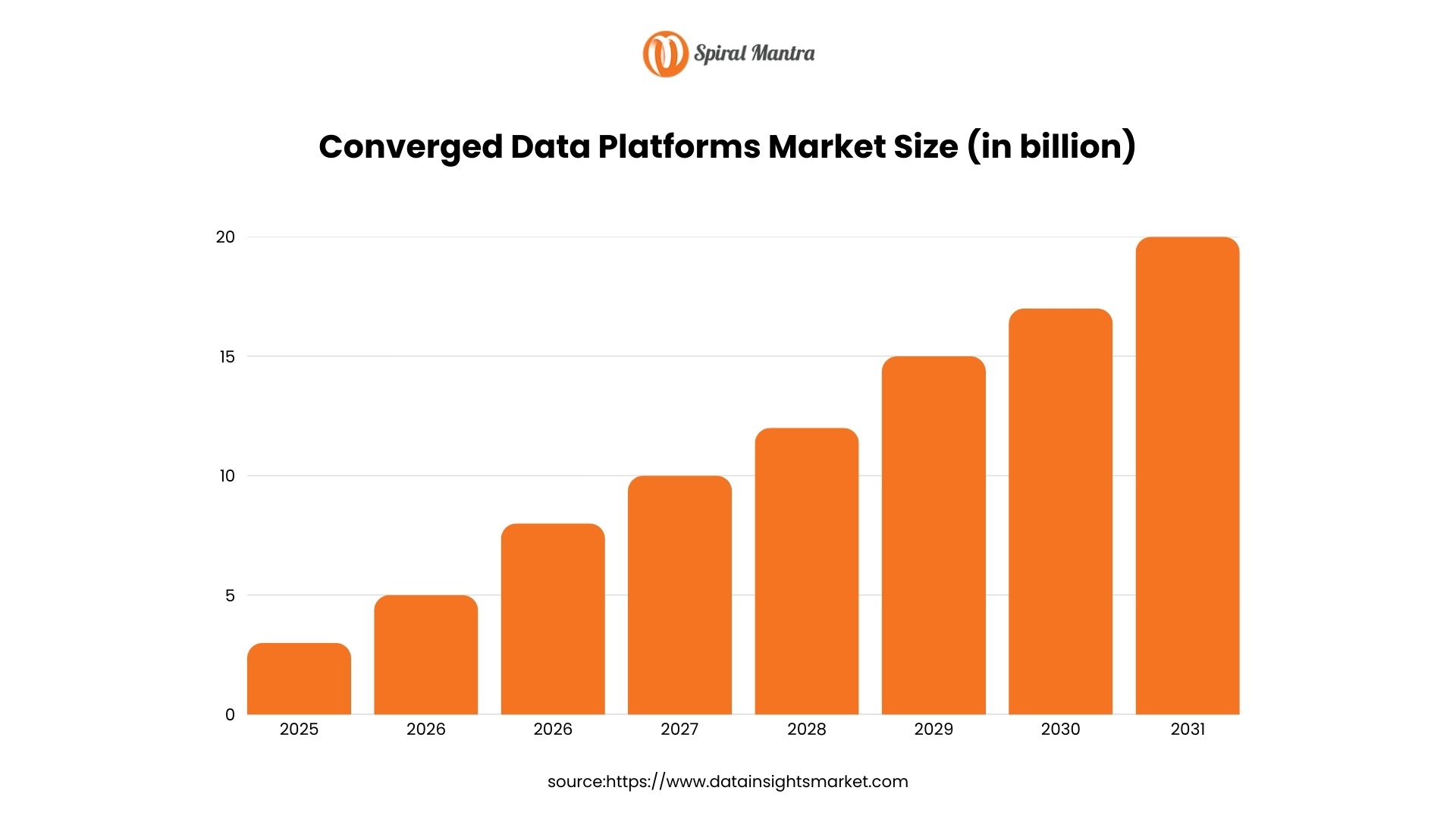
According to Gartner, the need for CDMP is expected to grow 14–26% annually between 2025 and 2032, as it transitions toward agentic AI, automated DataOps, and subscription-based models.
Today, converged platforms are being shaped by deep AI and machine learning integration. This allows independent, self-monitoring systems that bring together data storage, analytics, and governance within a single architecture.
As organizations continue to deal with growing data complexity, adopting a converged data management platform can provide long-term advantage.
Implementing a converged data platform requires careful planning. And for careful planning, connect with a reliable data integration partner like Spiral Mantra.
As a leader in data engineering services, we have helped several businesses design, implement, and improve their businesses' ROI with converged data platforms.
Are you interested in exploring how converged data platform could work for your business? Then connect with our experts today at sales@spiralmantra.com and get started.