Overview
Modern businesses are already drowned by data. In this modern era, every transaction, every click, every sensor pulse generates information that needs to be captured, moved, and transformed before it can actually help make decisions.
For years, data engineering teams have worked on fragile pipelines, ETL jobs, and managed non smooth integrations. And in all this, Zerobus Ingest is right at the center of that shift.
In this blog, we'll discuss what Zerobus Ingest actually does, why it matters for data engineering services today, and how it fits into the broader ecosystem of tools like Databricks or Azure DevOps. If you are a data architect evaluating platforms or a business leader trying to understand where your infrastructure spend should go, this is worth your time.
Zerobus Ingest: Definition and Why it Matters
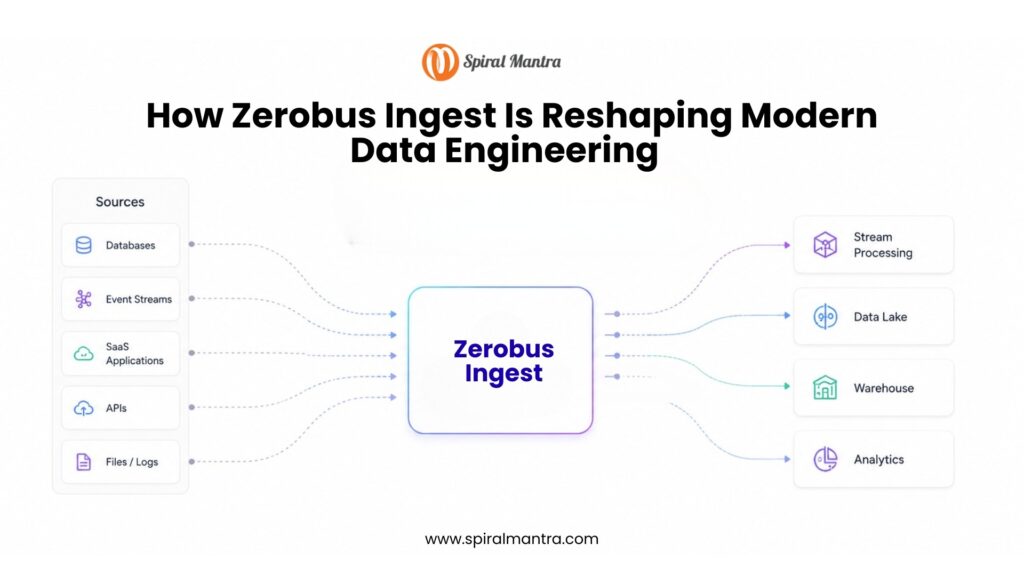
Zerobus Ingest is a high-performance data ingestion framework designed to simplify how businesses move data from source systems into analytical environments.
Let's think of it as the front door of your data stack, i.e., the layer that decides how cleanly and reliably raw data enters your pipelines before any transformation or analysis begins.
The core problem it solves is getting data from point A to point B, without creating a hiccup. In Traditional ingestion, their approaches such as batch jobs, cron-based scripts, and manually configured connectors often create bottlenecks. This happens because they are hard to monitor, harder to debug, and almost impossible to scale without significant re-engineering effort.
Zerobus Ingest addresses this by offering a unified ingestion layer that supports streaming and batch data sources simultaneously. And in case you are wondering about the result: Data engineering teams spend less time firefighting and more time building.
Challenges in Modern Data Engineering
To appreciate what Zerobus Ingest brings to the table, it's worth stepping back and looking at the broader landscape of data engineering services right now. Let's take a look at the stats now.
Data is increasing every day. According to many industry reports, global data creation was expected to exceed 180 zettabytes by 2025. Most of this data is distributed in forms such as SaaS apps, transactional databases, event streams, and IoT devices, and getting it into a single analytics platform is important.
Here's what modern data engineering teams are dealing with:
Schema drift — source systems change their data structure without warning, which breaks pipelines downstream
Latency requirements — business stakeholders want real-time dashboards, not numbers stuck in the past
Cloud difficulty—teams are balancing multi-cloud environments over AWS, Azure, and GCP
Governance and compliance — data must be tracked, masked, and analysed at every step
Scale unpredictability—traffic spikes can hamper ingestion layers built for steady-state loads
This is the reason why solutions like Zerobus Ingest are built. It is not an afterthought but something you hold onto once you have built warehouse or lakehouse.
An Overview on the Natural Partnership Between Zerobus Ingest and Databricks
Currently one of the most talked about integrations in the data space is Databricks Zerobus Ingest with that of the Databricks Lakehouse Platform.
Databricks has become popular for businesses to running large-scale data analytics and machine learning workloads. It uses Apache Spark, supports Delta Lake for secure data storage, and provides centralized data management with Unity Catalog. However, Databricks alone does not handle data ingestion. You still need to get data in cleanly and continuously.
That's where the Zerobus integration shines.
By feeding data directly into Databricks through Zerobus Ingest, teams get:
Regular data availability-streaming ingestion means your Delta tables are always up to date
Schema enforcement- bad data is caught before it ever touches your lakehouse
Less pipeline complexity-optimized ingestion patterns reduce the compute overhead on the Databricks side
Therefore, in our understanding, for businesses that have already invested in the Databricks ecosystem, adding Zerobus Ingest is more of a natural extension. It plugs into existing workflows without forcing a platform change.
Data Pipeline Automation by Zerobus
One of the biggest benefits Zerobus Ingest delivers is genuine data pipeline automation. Now let's take a look into why that is the case.
Traditional pipelines require manual intervention at multiple points. For example, someone notices a job failed at 3 AM, wakes up, logs in, checks logs, reruns the job, and hopes the downstream consumers haven't already sent bad reports to the leadership team.
And that definitely is not automation.
True data pipeline automation means:
Self-healing pipelines that automatically find and fix problems without human intervention
Dynamic scaling that adjusts ingestion data processing based on incoming data volume
Alerting and observability built in from day one, not retrofitted later
Declarative configuration so pipelines are defined as code, versioned, and reproducible
Zerobus Ingest shows these principles. And teams that adopt it speak about significant reductions in operational overhead.
This is a meaningful shift for any organization investing in data analytics services, where the quality and reliability of the underlying data directly determine the quality of insights delivered to the business.
Cloud Integration Across Azure, AWS & Modern Platforms
Modern data engineering works within cloud systems, so Zerobus Ingest must easily integrate with the platforms your team already uses.
For teams running on Microsoft's cloud stack, the connection between Azure and data pipeline management is increasingly important. Infrastructure-as-code, CI/CD pipelines for data workflows, and automated testing of data quality are no longer "nice to have" but are important for production-grade data engineering.
Zerobus Ingest fits neatly into Azure DevOps-managed workflows. Pipeline configurations can be stored in Git, changes reviewed through pull requests, and deployments automated through Azure Pipelines. This syncs up software engineering discipline to data engineering, which is something the industry has been pushing for under the banner of "DataOps."
If your teams are already working on Azure, our Azure DevOps consulting services can help you modernize your software delivery, and extend this practice to your data pipelines.
And the best part is that Zerobus Ingest makes it technically feasible without requiring a complete rearchitecture.
Many organizations are in the middle of or are at least planning to migrate to a cloud-native database on AWS. With our AWS database migration services, we handle a one-time lift of moving data from on-premises or legacy systems to cloud targets like Amazon RDS, Aurora, Redshift, or S3. But migration is just the beginning.
Once data is in AWS, you need ongoing ingestion for new data arriving every day. That's where Zerobus Ingest complements the AWS migration story. by handling the steady flow of new records and transactions so your freshly migrated databases stay current and your analytics environment reflects reality.
Business Value of Data Ingestion
Executives see value in dashboards, models, and reports. What they fail to see is the ordinary work of making sure data arrives reliably, completely, and on time. And that work is taxing.
When ingestion breaks, everything downstream breaks. Reports show numbers that are inaccurate, and machine learning models train on incomplete datasets. The end outcome is that business decisions get taken on bad datasets.
The ROI of investing in data engineering services and that of Zerobus Ingest are more ways than just one:
Lower incident response time
Faster and cleaner data availability
Lower operational costs
Scalability with major re-engineering
Future of Data Engineering in 2026
Data is only as useful as your ability to reliably move it, transform it, and make it accessible. And Ingestion gets it where it needs to go.
Zerobus Ingest is one of the more compelling answers to the ingestion problems. Its integration with platforms like Databricks, its compatibility with cloud ecosystems including Azure DevOps and AWS, and its support for genuine data pipeline automation make it worth serious consideration for any business looking to invest in data capabilities.
If you are a business (mid size or enterprise) looking to reduce operational overhead, Zerobus Ingest deserves to be on your shortlist.